Annex Property Reimagined
In 2023 the Town of Vienna sought feedback from residents, exploring the opportunity to construct a recreational aquatics and fitness center at 301 Center St., S. The result was conceptual designs for the project, include a state-of-the-art facility encompassing approximately 24,500 square feet with ample parking for visitors. The conception intends to cater to a wide range of recreational and fitness needs, ensuring a welcoming environment for all ages and physical abilities.
The Annex Project stems from a demonstrated and ongoing community need identified through multiple planning efforts over time. Community input(PDF, 1MB) gathered in 2013 during planning for the Vienna Community Center renovation(PDF, 2MB) indicated a strong interest in an aquatic amenity, and that feedback has continued to be reflected in more recent studies. In 2014 the Town Council determined(PDF, 103KB) that the cost to construct and operate such a facility was not financially feasible.
Learn more about various parks and recreation projects and initiatives in Our Plan to Plan, the Town's first-ever Parks & Recreation Master Plan.
Aquatic and Fitness Center Frequently Asked Questions (FAQs)
The Vienna Town Council and Town staff sincerely appreciate the community’s input as we explore options for the Annex Property at 301 Center Street S. These FAQs are intended to provide a clear overview of the project’s purpose, conceptual design, funding approach, and potential community impacts. We look forward to continuing a constructive conversation as we evaluate the financial and operational viability of the Aquatic and Fitness Center. If you have questions or additional feedback, please contact the Town Council at Council@viennava.gov. To view a pdf of all the FAQs click here(PDF, 812KB) .
Project Purpose
1. What is the purpose of the indoor aquatic and fitness facility?
- To provide year-round aquatics, expanded fitness programming, improved local access, and a long-term community asset focused on health and recreation for Vienna residents.
- To serve all residents of all ages and abilities without long wait lists and at an affordable price point, ensuring broad accessibility compared with membership-based private pools, which often have limited capacity or higher costs. By providing a publicly accessible option, the facility emphasizes inclusivity and community benefit for the entire town. To promote overall health and wellness, offering opportunities for regular exercise, fitness classes, and active recreation that support physical and mental well-being for the community.
Public Engagement & Survey Data
2. What opportunities have residents had to provide input on the project?
- Residents have had multiple opportunities to provide input statistically valid and community surveys, Town Hall meetings, public hearings, extended comment periods by email and mail, and broader parks planning efforts. This input has helped shape both the concept for the Aquatic and Fitness Center and the discussion about how the project could be funded and implemented. While the Town Council has held public meetings and accepted community feedback on this project, formal public hearings are not typically held for individual capital projects, such as the Community Center renovation or construction of the new Police Station.
- Annex Long-Term Use Study(PDF, 11MB): Outreach - When the Town explored uses for the former Annex property (301 Center Street South), it conducted community outreach and feedback sessions as part of the feasibility and planning process. Residents were invited to respond to questionnaires and participate in community meetings as the options were evaluated.
- The Kimley-Horn consulting team designed and launched an online community perspective questionnaire(PDF, 2MB) to understand community perspectives and unmet needs to better inform the study process. The questionnaire consisted of eight questions and was structured to help the team understand community attitudes and perspectives on the types of land uses that are valued or needed in general and specifically at the Annex site. The questionnaire was open from March 7, 2023, to May 1, 2023. A total of 1,204 respondents completed the survey.
- Town Hall Meeting (Oct. 22, 2024)
- The Town hosted a public town hall meeting where residents could learn about the Aquatic and Fitness Center concept, ask questions, and submit opinions in person.
- Public Hearing (Nov. 18, 2024)
- Vienna held a formal public hearing before the Town Council specifically related to the proposed temporary meals tax (a potential funding mechanism for the facility). Residents were able to speak during the hearing, which entered comments into the official record.
- Extended Public Comment (Through Nov. 27, 2024)
- In addition to the public hearing on Nov. 18, 2024, the Town Council kept the comment period open via email and written submissions for nearly two weeks afterward, giving residents more time to provide feedback.
- Surveys & Broader Recreation Planning Activities
- Residents also contributed input through the Town’s Park Master Plan(PDF, 58MB) process (“Our Plan to Play”), which included surveys and workshops that helped identify aquatic facilities as a community priority. Aquatics emerged as a top unmet need in that planning outreach. The master planning process included two surveys(PDF, 691KB): a statistically valid survey that was distributed, randomly, to Town residents and a community survey that was available online and open to anyone to provide responses. Each survey contained the same questions with the key difference being the methods of distributing the surveys and means of responding to the surveys. The community’s participation reflects a total response rate of 33 percent and the following statistical significance: the results represent a 95 percent likelihood that the statistically valid survey responses represent the perspectives of the entire town with a 5.35 percent margin of error.
- Ongoing Options for Engagement
- Town officials (including the mayor and council) continue to invite emails, calls, and written feedback on the project and related funding decisions, and future opportunities for public input will offer additional opportunities as the design and funding process moves forward.
3. Can the Town have a referendum on the general question as to whether the Town should build a public aquatic and fitness center?
The Town does not have the legal authority to hold a referendum on that question. While localities in Virginia may hold referenda on a range of issues, including gambling, alcohol sales, school board elections, bond issuance, and the creation of certain authorities, such referenda must be specifically authorized by law and conducted in accordance with statutory and constitutional requirements. Virginia does not permit “advisory referendums”.
Facility Size, Features, and Capacity
4. What would the size (4-lane and 6-lane pool) and capacity of the aquatic and fitness center be, and how many users could it accommodate at one time? What fitness opportunities would be offered?
- 4-lane, 25-Meter Pool
During the Annex Long Term Use Study(PDF, 11MB), with input from Town Council, staff, and the community, the Town’s consultant proposed a conceptual two-story recreational facility with a 4-lane, 25-meter swimming pool and multi-purpose community rooms on the ground level and fitness space on the upper level. This was an initial possible concept and may change considerably during the design phase based on community engagement and direction from the Town Council.
- Proposed facility area total - 30,255 square feet (SF)
- Pool Area: 16,115 SF (Estimated Water Surface Area: 5,500 SF)
- Fitness Area: 9,045 SF
- Support Area: 5,095 SF
- Maximum Occupancy
- Entire Facility 426 occupants
- Pool Area:
- 110 max occupants in pool water
- 55 max occupants on pool deck and classroom
- Fitness Area
- 131 max occupants in cardio & weight area
- 18 max occupants in fitness room 1
- 14 max occupants in fitness room 2
- Community Meeting Spaces:
- 38 max occupants in community room 1
- 49 max occupants in community room 2
- Expected Membership
- Vienna Residents: 9-12% of Households, or about 1,477 - 1,977 members
- Non-Residents: 1-2% of Households, or about 1,056 - 2,112 members
- Note: Membership totals do not represent the total number of individuals who may use the facility. The Aquatic and Fitness Center is expected to accommodate daily users, non-member program participants, and individuals enrolled in classes or lessons who may not be required to hold a membership.
- Fitness Opportunities(PDF, 209KB)
- Free Weights & Circuit Training, Cardio Equipment & Stretching, Turf Training, Fitness Instructional Teaching
- 6-lane, 25-Meter Pool
Based on initial feedback and information obtained from other community aquatic centers, a 6-lane, 25-meter pool has also been suggested. For pool project context, Town staff reviewed the size of comparable regional recreation facilities. The Ashburn Recreation Center, which is approximately 117,000 square feet, was used as a recent regional example. Because that facility is significantly larger and includes additional amenities, it is not a direct comparison. However, it helps illustrate the relative scale of the facility.
- Preliminary estimates, shown in Appendix A, indicate that a 6-lane, 25-meter pool facility would total approximately 39,757 square feet, including:
- Pool Area: 18,690 SF (Estimated Water Surface Area: 6,400 SF)
- Fitness Area: 13,567 SF
- Support Area: 7,500 SF
- Maximum Occupancy – Due to the increased square footage for the pool, fitness and support area, the occupancy capacity would increase with the design of the 6-lane pool.
5. How were the size and capacity of the Aquatic and Fitness Center determined? What was the initial budget?
The size and capacity of the Aquatic and Fitness Center were determined through the Annex Long Term Use Study(PDF, 11MB), which combined an operational analysis, market study, and community engagement process. The study projected the highest-performing facility in terms of scope, amenities, and scale, while considering the site’s physical capacity (approximately 3 acres) and applicable zoning restrictions, including required parking ratios, minimum setbacks from property lines, building height limitations, and lot coverage requirements. These factors were incorporated to ensure compliance with local land-use regulations while maximizing functional space. Based on these findings, the initial budget of $28 million for the facility was established to reflect the anticipated size, program offerings, operational requirements, and costs associated with meeting zoning and site-specific regulatory requirements. The initial thoughts were that this would be a local community facility and not a regional facility.
Comparison to Other Facilities
6. What other indoor pools or recreation centers are located near Vienna, and how accessible are they to residents?
The Annex Long Term Use Study(PDF, 11MB), prepared by the Town’s consultant, Kimmel Bogrette, defines the Primary Service Area (shown in red on Diagram 1 below) as the area people are typically willing to travel to on a daily or weekly basis approximately a 10-minute drive time.
To provide additional context, approximate distances from Town Hall (127 Center Street S., Vienna) are listed below. However, it is important to note that the Primary Service Area shown in Diagram 1 is based on drive time, not mileage, as traffic conditions can significantly impact how long it takes to travel.
- Spring Hill Rec Center – McLean, approximately 4 miles
- Providence Rec Center – Falls Church, approximately 7 miles
- Oakmont Rec Center – Oakton, approximately 4 miles
Diagram 1 – Primary Service Area
Annex Long-Term Use Study

*Oak Marr has since been renamed Oak Mont
7. Why did the Town Council vote to include an aquatic and fitness center in the CIP 2026-2042 despite nearby county facilities?
- The Town Council’s decision was informed by feedback from residents through the Annex Long Term Use Study(PDF, 11MB) and Park Master Plan, a statistically valid survey, and community workshops and surveys. These efforts consistently identified interest in indoor aquatics and expanded fitness opportunities within Town limits. While nearby county facilities are available, they do not fully meet Vienna’s locally identified demand, accessibility goals, or programming control needs. A Town operated facility would provide in-town access and local service oversight, benefiting residents such as families with young children, individuals with limited mobility, and swim teams that currently rent space at other facilities.
- Documented Community Demand –
- Through the Town’s parks planning process, including the Park Master Plan and prior community surveys, residents have identified indoor aquatics as a top unmet need(PDF, 691KB). Notably, the top two recurring priorities in Town surveys and planning efforts have been a community pool and expanded fitness opportunities. Statistically valid and community surveys(PDF, 2MB) along with public outreach have repeatedly shown interest in year-round swimming, lessons, and fitness programming located within Town limits, demonstrating sustained community demand for these facilities
- Long-Term Civic Investment
- The Aquatic and Fitness Center has been framed as a long-term community asset that would:
- Local Access & Walkability
- A facility located within Vienna:
- Improves access for youth, seniors, and families.
- Reduces travel time.
- Supports walkability and bike access.
- Keeps recreation activity within the community core.
- Program Control & Community Use
- By operating its own facility, Vienna could:
- Set local programming and rental priorities.
- Provide expanded community access to aquatics programming and lessons.
- Offer dedicated time for Vienna-based teams or groups.
- Integrate aquatics with fitness, senior programming, and community events.
- Provide additional space for exercise and wellness classes, addressing demand that currently exceeds capacity at the Vienna Community Center and freeing up room there for other programs.
- County facilities must balance demand across a much larger population.
- See FAQ #15 to learn more about membership fees.
- See FAQ #16 to learn how programming and membership will be made accessible to underserved populations.
- Provide a public amenity accessible to people of all abilities.
- Serve multiple generations of residents.
- Support health, wellness, and recreation opportunities within Town limits.
Cost, Financing, and Taxes
8. What is the estimated cost of the Aquatic & Fitness Center, and could that change?
- The total cost to design and build the Aquatic and Fitness Center with 4-lane pool is currently estimated at $28 million in the current CIP(PDF, 33MB). This estimate may change as design details are refined, bids are received, and inflation assumptions are updated.
- The determined cost per square foot is $770, providing a recent benchmark for evaluating potential build costs of the current conceptual design, including 4-lane, 6-lane, and 8-lane pool options.
- As part of its review, Town staff analyzed construction costs per square foot using the Ashburn Recreation Center as a regional reference (see Appendix A). That facility is approximately 117,000 square feet, compared with Vienna’s projected Aquatic and Fitness Center of about 30,255 square feet for a 4-lane pool and 39,757 square feet for a 6-lane pool. While the Ashburn facility is significantly larger and therefore not a direct comparison, it provides a useful benchmark for gauging potential construction costs for different pool configurations.
- The estimated cost for a 6-lane, 25-meter pool, based on the analyzed construction costs per square foot, is approximately $36 million, as shown in Appendix A.
- While the estimates cited are indicative of the general magnitude of the capital costs for construction, the Town will have a more refined estimate of the actual cost of building the facility on this site when the design team begins its work. Final costs will depend on the programs included, the building’s exact size and configuration, site conditions, and other Vienna-specific factors. Updated estimates will be shared as the design process moves forward.
- The CIP(PDF, 33MB) includes funding for the project, and is updated annually, with the next update scheduled for Summer 2026.
9. How does the Town plan to fund this project?
- Nov.10, 2025 – Town Council executed an agreement with Navy Federal Credit Union (NFCU) authorizing the Town to accept a $3 million interest-free advance to fund initial project management and design services. Due to the agreement, the Town is saving several hundred thousand dollars in interest costs through 2030.
- Nov. 10, 2025 – Town Council held a public hearing regarding the issuance of $16,905,000 in General Obligation (GO) bonds, previously included in the adopted CIP.
- Dec. 2, 2025 – Town Council awarded the sale of the approved bonds. The proceeds from these bond sales (as well as unused balances from prior bond sales) must be used for the specific capital projects for which they were authorized. Specific projects include the Aquatics and Fitness Center, road and sidewalk improvements, and long-term maintenance needs for other town assets, including parks, public works facilities, and police station.
- The Town also plans to fund the capital construction costs of the aquatic and fitness center primarily through the meals tax, existing capital funding, and potential community contributions, rather than an increase in the real estate tax rate. This approach helps to minimize impacts on other Town services and infrastructure, including parks, roads, and public facilities.
- The Town Council has authorized a capital fundraising campaign to identify potential community contributions.
10. Why did Town staff recommend an increase of the meals tax from 3% to 4%?
- The Town Council asked how an aquatics and fitness center could fit in the Town’s Capital Improvement Plan (CIP). During the CIP analysis, the model demonstrated capacity for an aquatics and fitness center in 2038 with the meals tax remaining at 3% or 2028 with the meal tax increasing to 4%. While there is no percentage specifically dedicated to any one project, all funds from the Town of Vienna meals tax pays for all debt service related to planned general government Capital Improvement Projects. Project examples include streets, facility maintenance, and new construction such as the Aquatic and Fitness Center.
11. What is the Town’s financial oversight and credit review?
- During the bond issuance process, Town staff worked closely with the Town’s independent financial advisor to ensure that:
- The full FY 2026–2042 CIP(PDF, 33MB) remains financially sustainable
- Revenue assumptions are conservative
- Debt service remains manageable within existing financial policies
- As part of the financing process, national rating agencies S&P Global Ratings and Moody’s Investors Service conducted independent credit reviews and reaffirmed the Town’s AAA bond ratings, reflecting:
- Strong financial management
- Conservative long-term planning
- Stable revenue structure
- Manageable debt levels
12. What is the Town’s project financing structure?
- The $3 million interest-free advance from NFCU will fund initial project management and design services.
- The advance will be repaid as part of the Town’s planned 2030 bond issuance.
- The Town plans to finance construction costs and the advance repayment through the Town’s general obligation bonds as part of the 2028 and 2030 bond cycles, reduced by the amount raised through the capital fundraising campaign.
- Town general obligation debt is repaid using Meals Tax revenues.
- Donations from the community.
Operating Costs & Long-Term Sustainability
13. What are the projected annual operating costs and revenues, and how were they determined? Was there an independent review of the operating costs?
- Initially, the Town’s independent consultant reflected an operating subsidy from $500,000 in the first year of operations, reducing to $340,000 in year 5 with cost recovery ranging from 76% to 86% (see Diagram 2). Diagram 2 illustrates that, under the consultant’s and Town staff’s projections, annual operating expenses are expected to exceed annual revenues, resulting in an operating deficit (or subsidy) each year. The chart compares a more optimistic consultant model with a more conservative Town staff model to show a range of potential outcomes. Town Staff recommended an approach that was the “worst-case scenario to use the most conservative assumptions to assess the economic viability of such an operation and the impact. Town staff projected a cost recovery of 20% to 51%, significantly below the Town’s consultant, Kimmel Bogrette’s findings, which increased the operating subsidy from approximately $1,000,000 to $1,600,000 in the early years of operations.
Diagram 2 – Comparison of Expense and Revenue Projections
Annex Long-Term Use Study vs. Conservative Staff Estimates
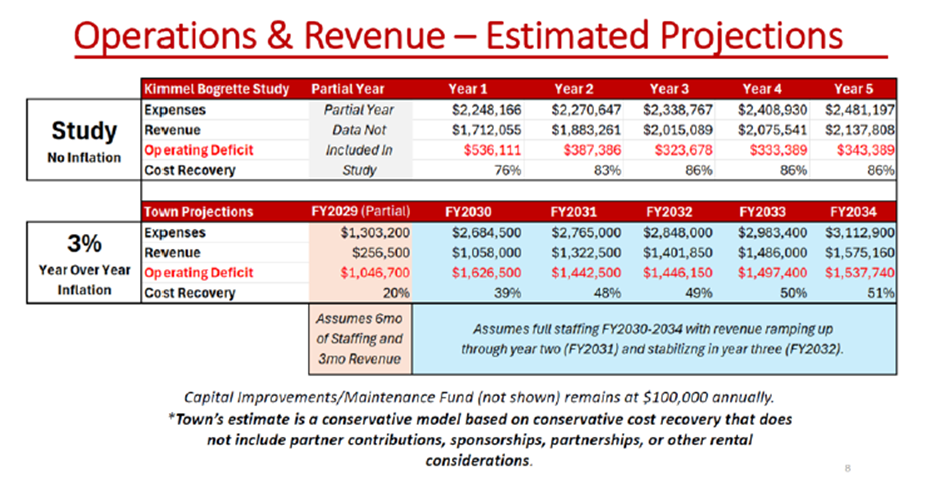
- Because expenses are projected to exceed revenues, the operating deficit (subsidy) would be funded through the Town’s general fund, like the way other community services, such as the Community Center, are supported. The projected operating subsidy will be funded through the general fund budget, just as the community center is being funded with a yearly operating subsidy. Funding for the operating subsidy has already been approved by the Town Council in the Fiscal Year 2025-26 Operating Budget(PDF, 31MB) ($200,000). Town staff plan to present a phased funding approach to the Town Council, gradually increasing the subsidy over time as the facility moves closer to opening and operations stabilize. This is demonstrated by an increase to the operating budget in the proposed FY26-27 Operating Budget.
- The operating cost projections(PDF, 1MB) were independently reviewed by the Town’s consultant, Kimmel Bogrette, to validate assumptions and financial modeling and presented to Council during a Council work session on June 10, 2024.
- The Town also evaluated options to reduce the operating deficit, such as adjusting program offerings, pricing strategies, and facility design. For example, adding competitive swimming features may increase revenue potential, but it would also increase operating costs. As a result, changes to the facility do not guarantee a reduced subsidy and must be carefully balanced.
- As the Town is planning for the project design and construction phase, preparations are underway to structure the operational budget so that expenses can be covered without increasing the real estate tax rate or reducing existing Town services. The following projections referenced in Diagram 2 are illustrative and were presented at the Town Council work session on Jan. 21, 2025.
14. How will the facility’s final design and programming affect projected operating costs and revenues?
- Updated operational and revenue estimates will be developed after the design team works with the Town Council to determine the facility’s final layout, programs, and amenities. Certain design and programming decisions can significantly increase revenue and reduce the projected operating deficit; however, the full impact will not be known until the design phase advances and key decisions are made. As those decisions are finalized, updated financial projections will be provided.
15. Will membership or usage fees be required, and how do they compare to other regional facilities?
- Yes, fees would be charged to both residents and non-residents, with a goal of remaining comparable to, or lower than, nearby jurisdictions. Preliminary estimates from the 2024 feasibility study included an annual resident membership of about $660 ($55/month) for individuals and $840 ($70/month) for households. These were planning assumptions only and are expected to change prior to opening based on inflation, operating costs, and market conditions. Daily admission passes would also be available. Final fees will be set closer to the facility’s opening.
- Non-resident fees are expected to be approximately 25% higher than resident rates.
16. How will programming and membership be made accessible to underserved populations?
The Town is committed to ensuring access to Aquatic & Fitness Center programs and memberships for all residents. Residents who qualify based on the Town’s existing scholarship program will receive financial assistance to participate in programs. Additional details on programs, membership options, and eligibility will be provided if the project moves forward and more information becomes available.
17. What are the anticipated long-term financial impacts on taxpayers?
- At this point, there are no anticipated long-term impacts on the real estate tax rate. However, as part of the annual budget preparation process, future budgets are subject to staff review and Town Council approval.
- Annual operations and maintenance will be funded through facility fees and a variety of general fund revenues, which consist of local taxes and fees (Real Estate Tax, Business License Tax, State Sales Tax, Bank Franchise Tax, Utility Taxes, Vehicle License Tax, etc.).
Project Approval & Governance
18. What has Town Council voted on?
- The Aquatic and Fitness Center is a project passed by a vote for future planning within the Town’s Long-Term CIP(PDF, 33MB) for FY 2026–2042.
- Sept. 15 & Oct. 20, 2025 – Town Council held public work sessions reviewing the CIP, including the Aquatic and Fitness Center.
- Oct. 27, 2025 –Town Council formally adopted the FY 2026–2042 CIP, which includes design, project management, and construction planning for the Aquatic and Fitness Center.
- Nov. 10, 2025-Town Council executed an agreement with Navy Federal Credit Union (NFCU) authorizing the Town to accept a $3 million interest-free advance to fund initial project management and design services. The Town has not yet drawn on these funds. When used, this interest-free advance will help cover early project costs while saving several hundred thousand dollars in potential interest expenses compared with traditional financing.
19. Has the Town Council voted on the construction of the Aquatics and Fitness Center?
- The Town Council has not voted on final construction nor committed to build the Aquatic and Fitness Center. At each future decision point, including awarding contracts, approving final designs, and authorizing construction, the Council will evaluate whether to proceed with the project before any commitment is made. Each step requires separate approval, at a public meeting, ensuring that the threshold question of whether to continue is considered at every stage of the project.
20. Why would it be beneficial to hire a project manager now?
- The Town does not employ “in-house” construction project managers. For capital projects of this scale, it is a best practice to hire a project manager early in the process to oversee planning, design, and eventual construction. This ensures schedules, budgets, and quality standards are closely monitored, coordinates work between architects, engineers, and contractors, and provides professional oversight to manage risks before major construction begins. The project manager’s cost would be funded through the project’s capital budget as part of overall project management and development expenses.
21. What safeguards are in place to control costs during design and construction?
To control costs during aquatic design and construction, the project follows a structured review process at key milestones.
- A Clearly Defined Budget from the Start
- A target budget is established early. The design team aligns the pool size, features, and systems with that budget before details are finalized.
- 50% Schematic Design Review - To identify any project concerns before they become too expensive to correct.
- The layout and major systems are identified.
- A preliminary cost estimate is prepared.
- If the estimate is over budget, adjustments are made early (before the design is too detailed).
- 100% Design Development with Cost Reconciliation - Ensure the project is fully aligned with the budget before bidding
- Equipment and materials are more defined.
- A detailed cost estimate is completed.
- The estimate is compared to the budget line by line.
- Any differences are addressed before moving to the final construction documents.
- Ongoing Safeguards
- A professional project manager to advise the Town Council and Town Manager.
- Value engineering if needed (finding cost-saving alternatives).
- Independent cost estimating or construction manager input.
- Formal approval process for scope changes.
- Contingency funds are built into the budget.
- Optional features identified as alternates.
22. What happens if the Town pauses the Aquatic and Fitness Center project and waits a year or two before moving forward?
- If the project is delayed, the Town would need to re-evaluate its Capital Improvement Plan (CIP)(PDF, 33MB) for future project years, including potential impacts to project sequencing, overall financing assumptions, and bond capacity.
- Any future bond issuance would also be subject to market conditions and interest rates at the time of financing, which could further affect the project schedule and costs.
- A delay in the project timeline would require coordination with Navy Federal Credit Union to confirm its willingness to adjust the previously discussed advance agreement and could affect the terms or timing.
- A delay could impact future partnership agreements associated with the project.
Funding Priorities, Infrastructure Maintenance, and Project Transparency
23. What is the status of the Aquatics and Fitness Center?
24. How will the Town be able to maintain parks and other infrastructure with so much money going towards the construction of a fitness and aquatics facility?
- The current Capital Improvement Plan (CIP)(PDF, 33MB) reflects adjustments in project timelines to allow financial resources to be reallocated to support the construction of the Aquatics and Fitness Center. This is the same practice and approach that is used every year as the CIP is updated when new priorities and projects are identified.
- The Town’s current Capital Improvement Plan (CIP)(PDF, 33MB) goes through 2042. The Town is planning to increase the level of park maintenance and infrastructure improvements through its normal CIP(PDF, 33MB) update process. The Town expects to increase the level of commitment based on the Park Master Plan. The annual operations and maintenance costs of the Aquatic and Fitness Center will be budgeted alongside other Town priorities as the Town continuously evaluates its CIP(PDF, 33MB) to balance funding for all infrastructure needs.
25. How does the Town ensure transparency and accountability for a project of this size?
- The following mechanisms are regularly used to provide both financial oversight and public visibility for all major capital construction projects:
- Review and approval through the Town’s annual public budget and Capital Improvement Program (CIP) process
- Open meetings, public hearings and recorded votes
- Phased design with cost reconciliation
- Competitive procurement, with awards of any construction contracts at a public meeting.
- Financial reporting and audits
- Contract oversight and change order controls
- Public information and project updates
Land Use & Alternatives
26. What alternative uses were considered for the property?
- The following represent the top priorities that were identified as part of a community engagement campaign to explore long-term uses of the Annex site:
- Community, Wellness, & Aquatics (Aquatics and Fitness Center)
- Community & Wellness Program (Fitness Center)
- Outdoor Community Gathering Program (Covered Pavilion/Gathering Space and Park)
- These top priorities were derived from multiple engagement opportunities, including two public workshops and a community survey.
- On June 10, 2024, four options were presented to the Town Council for consideration:
- Option 1 – Community, Wellness, and Aquatics (Lap Pool + Instruction)
- Option 2 – Community, Wellness, and Aquatics (Leisure Pool)
- Option 3 – Community & Wellness Program (Fitness)
- Option 4 – Outdoor Community Gathering Space
- Town Council supported further investigation into Option 2.
- On Sept. 30, 2024, the Town Council agreed through verbal vote to move forward with the continued exploration of the recreational or leisure-style pool and fitness center (Option 2).
27. What site constraints limit alternative uses of the property?
- The limits of the Annex site are determined by the Town’s planning and zoning regulations. Limitations would include the zoning designation, the overall size of the parcel, setbacks, stormwater management requirements, and the amount of parking required.
- The property is currently zoned RS-10 (single-unit residential), which is intended for single-family residential use. Other uses, including park use, are permitted with the issuance of a Conditional Use Permit.
- To build an Aquatic and Fitness Center on the Annex site, or other recreational use, Town Council would need to seek a Conditional Use Permit or change the zoning of the property.
Appendix
Conditional Use Permit
Town staff continue to explore temporary and long-term uses for the Annex property to ensure it provides community benefit while future plans for the site are evaluated. At the Oct. 8, 2025, Planning Commission meeting, the Commission reviewed a conditional use permit request for a series of governmental and public outdoor parks and recreational uses at 301 Center Street South.
On October 21, 2026, the Town’s Board of Zoning appeals approved the request for a Conditional Use Permit per Section Sec. 18-304. of the Town Code, for governmental and public outdoor parks and recreational uses at 301 Center Street South, known as “The Annex”, located at 301 Center Street South, owned by the Town of Vienna, to be managed by the Department of Parks and Recreation.
The following limitations are set for activities and activities:
Mondays through Saturdays
- Activities are permitted from 7:00 a.m. to 9:00 p.m.
- Parking is permitted from 7:00 a.m. to 11:00 p.m.
Sundays
- Activities are permitted from 9:00 a.m. to 9:00 p.m.
- Parking is permitted from 7:00 a.m. to 11:00 p.m.
Overnight parking is not permitted unless approved as part of a Special Event permit.
This Conditional Use Permit must be reviewed by the Board of Zoning Appeals every 12 months for review to recertify the approval of the Conditional Use Permit. At that time, the Board of Zoning Appeals will consider how the site has been managed relative to the criteria listed in Section 18-824.5.B., and may continue the permit, not continue the permit, change the conditions, and/or apply a new timeframe for review.
For more information about the conditional use permit and project updates, contact Leslie Herman, Director of Parks and Recreation, at 703-255-6356.
Proposed Facilities
The proposed aquatics portion of the center spans approximately 12,000 square feet, featuring a pool specifically designed for recreation and leisure activities. The fitness section of the building covers approximately 9,000 square feet and is designed to support a variety of exercise routines.
Additional Amenities
Beyond the primary aquatics and fitness areas, the conceptual center includes a welcoming lobby, rental rooms, and office space for administrative functions. To accommodate guests' comfort and privacy, there are restrooms, locker rooms, and family change rooms, offering convenience for individuals and families alike.
The potential aquatics and fitness center is designed with the community in mind, providing a comprehensive and accessible space for recreation, fitness, and family fun.
For details see the presentation and final report provided to the Town Council on September 30, 2024:
Annex Long Term Use Study Presentation(PDF, 16MB)
Annex Long Term Use Study Final Report(PDF, 11MB)
Appendix A- Existing Building Review(PDF, 11MB)
Appendix B- Vienna Annex Engagement Summary(PDF, 2MB)
Appendix B- Attachment A(PDF, 157KB)
Appendix B- Attachment B(PDF, 1MB)
Appendix C- Operational Planning Report(PDF, 1MB)
Appendix D- Program Narrative(PDF, 209KB)
What Was the Annex Long Term Use Study?
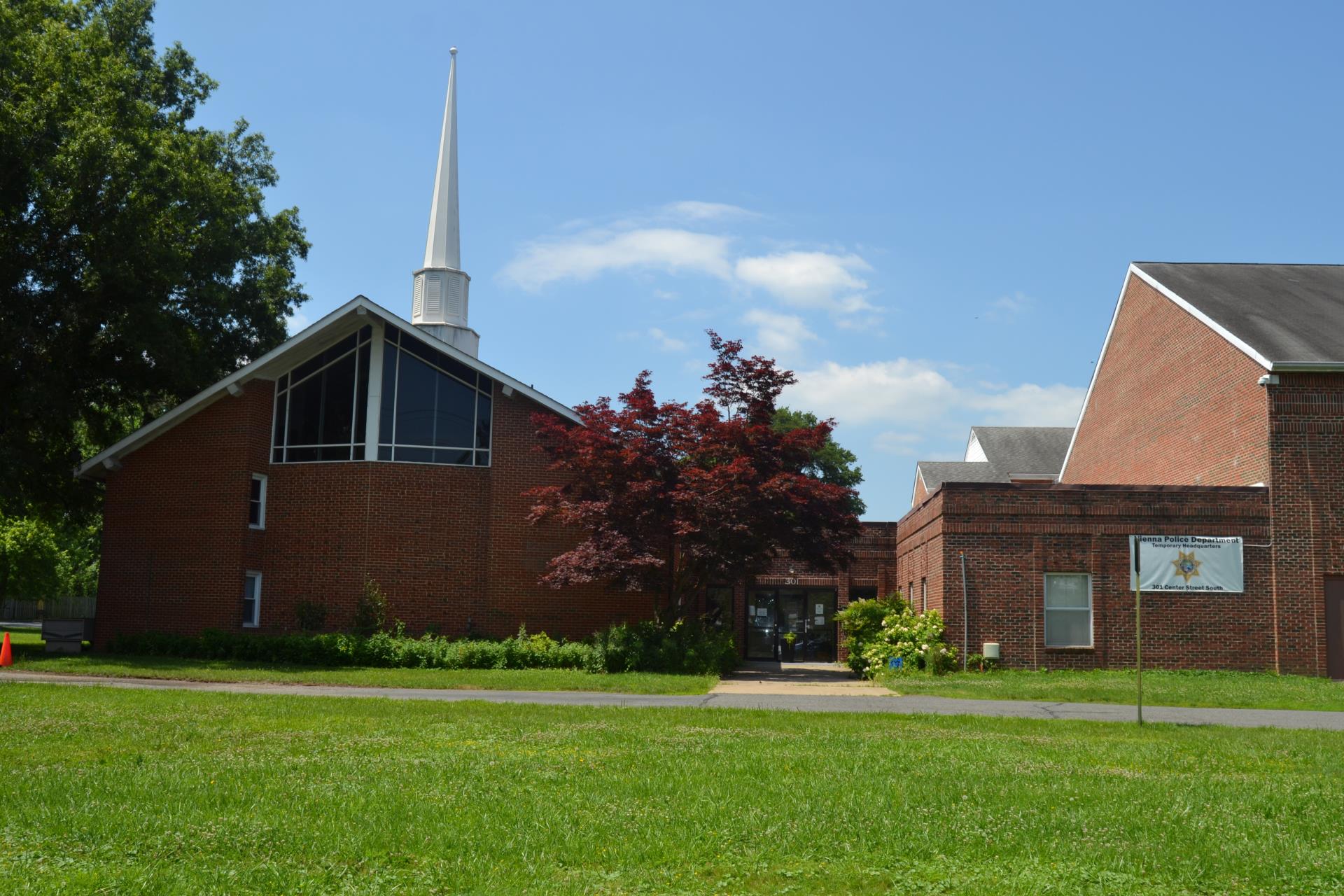 The Town of Vienna retained a consultant team led by Kimmel Bogrette Architecture + Site to conduct a land feasibility and community needs assessment of long-term uses for the Annex property at 301 Center Street S. The study provided recommended land uses based on the Town's strategic plan, comprehensive plan, extensive community engagement and available funding. Other planning efforts being considered when making a final decision include:
2024 Feasibility Study
Since the project's inception, community input was gathered through questionnaires and public workshops to identify potential uses for the property. A feasibility study projected total construction and operating costs associated with the most favored option to inform a final decision made by the Town Council. The feasibility study was intended to ensure that the final choice is both appropriate and financially viable. The feasibility examined the following:
- Determining the optimal use of the site and assessing what fits within its parameters.
- Identifying the potential best use(s) of the site.
- Ensuring that the selected uses align with and are compatible with the surrounding neighbors.
- Investigating the sustainability of the proposed uses to confirm their long-term viability.